.webp)
Home / space / Scientists Solve the Mystery of the Universe's Missing Matter Using Fast Radio Bursts
Scientists Solve the Mystery of the Universe's Missing Matter Using Fast Radio Bursts
By: My India Times
7 minutes read 2Updated At: 2026-07-22
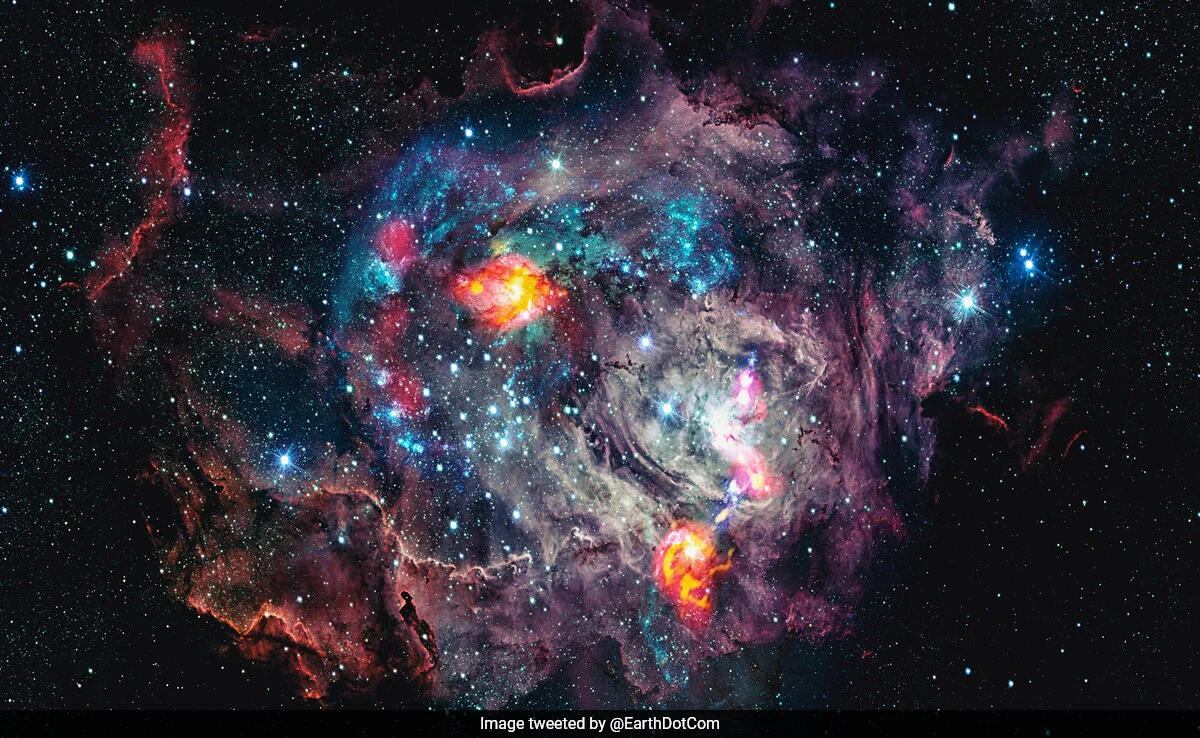
Scientists Discover the Universe's Missing Matter in Major Space Breakthrough
For decades, one of astronomy's greatest mysteries has puzzled scientists around the world: Where is the universe's missing matter? While theoretical models have consistently suggested that ordinary matter should exist in much larger quantities than astronomers could actually observe, nearly half of it appeared to be missing from the cosmic inventory.
Now, an international team of researchers has taken a significant step toward solving this mystery. Scientists working with the Canadian Hydrogen Intensity Mapping Experiment (CHIME), in collaboration with researchers from the Massachusetts Institute of Technology (MIT) and McGill University, have developed a groundbreaking technique that successfully identifies where much of this hidden matter resides. Their discoveries not only clarify the location of the missing stuff but also offer new perspectives on the evolution of galaxies and their interactions with the vast cosmic environment.
What Is the Universe's Missing Matter?
The "missing matter" is not the same as dark matter, which is still one of the greatest mysteries in contemporary physics, despite the term. Instead, the missing matter refers to ordinary matter, also known as baryonic matter. This is the familiar material that makes up stars, planets, gas clouds, galaxies, and even human beings. The approximate amount of ordinary matter that should exist is determined by cosmological calculations based on observations of the early cosmos. However, astronomers regularly discovered that a significant amount of normal matter was absent when they totaled everything they could directly detect, including stars, galaxies, nebulae, and interstellar gas. This discrepancy has challenged astrophysicists for years and prompted an extensive search across the universe.
Fast Radio Bursts Become Powerful Cosmic Tools
The latest discovery was made possible through the study of Fast Radio Bursts (FRBs). These extraordinary cosmic events produce incredibly bright flashes of radio waves that last only a few milliseconds. Astronomers assume that very intense cosmic processes occurring billions of light-years away are the source of many FRBs, even if their precise origin is still being investigated.
As these radio signals travel across the universe, they pass through enormous amounts of gas and plasma. Every cloud of matter slightly slows and disperses the radio waves, leaving behind a measurable signature. Researchers discovered that they could calculate the amount of matter between Earth and each FRB source by closely examining these minuscule delays.
In effect, every fast radio burst becomes a flashlight illuminating otherwise invisible material scattered across the universe.
CHIME and DESI Combined Their Strengths
To perform the study, researchers combined observations from two world-class scientific instruments. The first was the Canadian Hydrogen Intensity Mapping Experiment (CHIME), a highly specialized radio telescope located in British Columbia, Canada.CHIME continuously scans the sky, detecting hundreds of Fast Radio Bursts every year. The second was the Dark Energy Spectroscopic Instrument (DESI), located at Kitt Peak National Observatory in Arizona, USA.DESI has mapped the positions of more than 30 million galaxies, making it one of the most comprehensive surveys of the large-scale structure of the universe. By combining these two enormous datasets, researchers were able to compare FRB signals with the known locations of galaxies. This allowed them to determine where ordinary matter is concentrated and where it exists as diffuse gas surrounding galaxies.
More Than 2,800 Cosmic Signals Examined
The research team analyzed 2,870 Fast Radio Bursts, making it one of the largest FRB-based studies ever conducted. Each radio burst provided valuable information about the amount of material lying between its source and Earth. By comparing the dispersion of these signals with galaxy locations, scientists discovered that much of the universe's missing ordinary matter is not inside galaxies themselves. Instead, it exists in enormous, extremely thin clouds of hot gas surrounding galaxies and galaxy groups. This diffuse material is so faint that traditional telescopes struggle to detect it directly, explaining why it remained hidden for so long.
Missing Matter Extends Far Beyond Galaxies
One of the most surprising findings was the enormous size of these invisible matter clouds. Previous computer simulations suggested that the gas surrounding galaxies would remain relatively close to them. However, the new observations indicate that this material extends roughly four million light-years away from galaxies. This distance is significantly larger than many existing theoretical models had predicted. The discovery suggests that galaxies influence their surrounding environment much farther than previously believed. It also provides important clues about how matter moves across the cosmic web connecting galaxies throughout the universe.
Black Holes and Stellar Explosions May Be Responsible
Researchers believe the missing matter was likely pushed away from galaxies over billions of years through powerful astrophysical events.
These include:
- Supermassive black hole jets
- Supernova explosions
- Stellar winds
- High-energy galactic outflows
Such energetic processes can eject enormous quantities of gas into intergalactic space. The new findings indicate that these mechanisms may be far more powerful and efficient than earlier models suggested. Rather than remaining inside galaxies, large amounts of ordinary matter appear to have been expelled into the surrounding cosmic environment.
Why This Discovery Matters
Understanding where ordinary matter exists is fundamental to understanding how the universe works. Matter is the building block of stars, planets, galaxies, and life itself. Locating this missing matter helps scientists answer several major questions, including:
- How galaxies form and evolve.
- How black holes influence galaxy growth.
- How gas cycles through galaxies.
- How the large-scale structure of the universe develops.
- How ordinary matter interacts with dark matter and dark energy.
This breakthrough therefore extends far beyond solving a single mystery—it improves our understanding of the evolution of the cosmos itself.
Fast Radio Bursts Could Transform Astronomy
Scientists say this study demonstrates the remarkable scientific value of Fast Radio Bursts. Only a few years ago, FRBs were considered mysterious cosmic curiosities. Today, they are becoming one of astronomy's most powerful investigative tools. As CHIME continues discovering thousands of additional radio bursts in the coming years, researchers expect increasingly accurate maps of invisible cosmic matter. Future observations could reveal even finer details about the universe's structure and provide new opportunities to study phenomena that were previously impossible to observe directly.
A New Era in Cosmic Exploration
The success of this research highlights the importance of combining multiple observational technologies. By integrating radio astronomy with massive galaxy surveys, scientists can now investigate questions that once seemed impossible to answer. The study also demonstrates how international collaboration between institutions such as MIT, McGill University, and the CHIME Collaboration continues to drive major advances in astrophysics. Researchers believe this technique will become increasingly powerful as future telescopes produce even larger datasets.
Looking Ahead
Astronomers are optimistic that this discovery marks only the beginning. Upcoming observatories, including the Square Kilometre Array (SKA) and next-generation space telescopes, are expected to detect many more Fast Radio Bursts and map the universe with unprecedented precision. These future missions could help answer remaining questions about dark matter, dark energy, galaxy formation, and the overall evolution of the universe. Each new observation brings scientists closer to constructing the most complete picture yet of the cosmos.
The discovery of the Universe's Missing Matter represents one of the most important astronomical breakthroughs of recent years. By using Fast Radio Bursts as natural cosmic probes, researchers have successfully located ordinary matter that had remained hidden from view for decades. Rather than being confined within galaxies, much of this matter exists in vast, diffuse clouds stretching millions of light-years into intergalactic space. The findings not only solve a longstanding cosmic mystery but also provide new insights into how galaxies evolve, how black holes shape their surroundings, and how the universe itself is structured. As technologies like CHIME continue to detect more Fast Radio Bursts, scientists expect even greater discoveries that will deepen humanity's understanding of the universe and its origins.
....Independent reporting, fact-checked analysis and breaking news coverage from India and around the world.
Trusted source for breaking news, business, technology, world affairs, finance, economy, health, sports and market insights from India and around the globe.
Join our WhatsApp Channel












































































































.png)
 (1).png)